




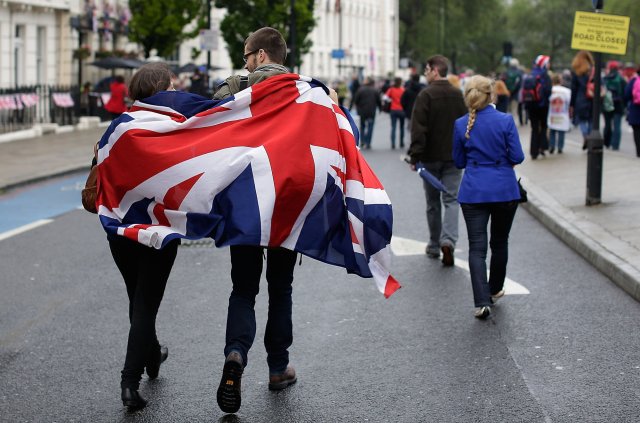





As our exit from Europe continues to dominate daily politics, other, vitally important areas are being neglected. So what should our politicians’ priorities be once we are beyond Brexit? We asked various contributors to draw up a pledge card for a post-Brexit manifesto.
Two little words have started echoing through my mind like an ear worm: “only connect”. And it’s not for any love of Victoria Coren Mitchell, because frankly I hate quiz shows where I don’t know all the answers.
The words that haunt me are the refrain of Anna Fox, the lonely, broken anti-hero of last year’s hit novel, The Woman in the Window. She in turn borrowed them from EM Forster, who wrote in Howard’s End:
Only connect! … Live in fragments no longer. Only connect, and the beast and the monk, robbed of the isolation that is life to either, will die.
Britain, the country I love, is living in fragments. Tearing ourselves to pieces, building identities for our tribe dependent on how much we hate the outsiders. The beast and the monk are indeed the figureheads of today’s political movements: the angry, destructive force of nature pitted against the over-educated technocrat who knows nothing of real life.
A country cannot continue being this angry with itself. So my pledge card would be focused on one goal: bringing Britain back together. And I would call my manifesto Only Connect.
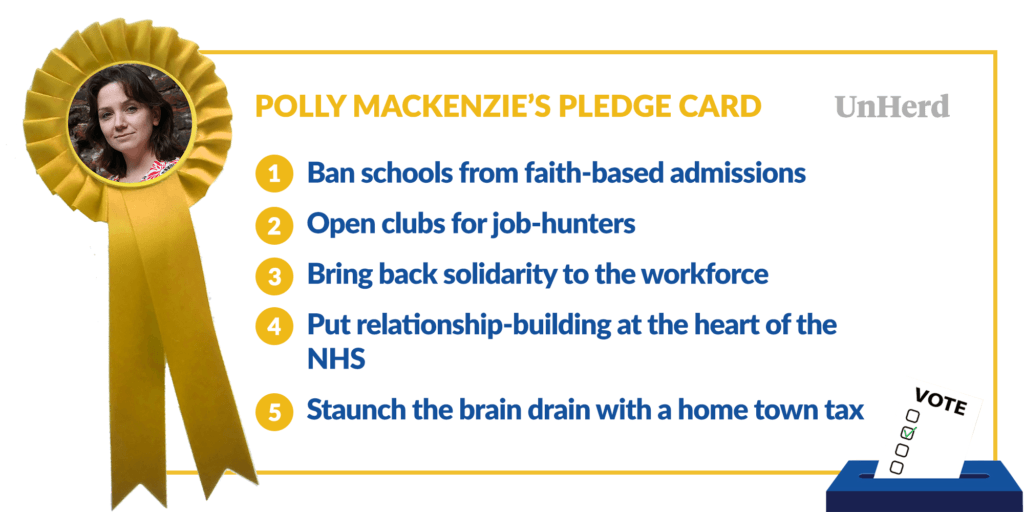
1. Ban schools from faith-based admissions
Faith of all kinds deserves a vital, special place in our diverse society. But it cannot be allowed to segregate our children and their parents. It’s time to ban faith-based admissions. Schools are our best asset in the effort to build a connected society. Our children are too open and nimble to succumb to prejudice against those who look and sound different, and they bring their parents along with them – at the school gate, on play dates and over slices of too-sweet birthday cake wrapped in soggy napkins.
I have no desire to deny parents the right to bring up their children in faith. But children spend only about a third of their waking hours at school: there is plenty of time and space for scripture, for practice, and for building bonds within a faith community. If we want more time for faith, let’s open state-funded faith education in after-school clubs or during weekends and holidays. But let our children be together to learn the things they all need to know.
2. Open clubs for job hunters
Grown-ups need human connection, too. So my second proposal is to open job clubs, for everyone who’s out of work or wants to find a better job. These peer-to-peer support clubs should be a core part of our welfare state – a place to make friends and connections, and get help from people who really understand what you’re going through.
We assume that tiny pots of money are enough to keep people going when they’ve lost their jobs. Our welfare state should certainly be more generous. But it should also offer more than just cash dispensed by a computer after you fill in a form. You should be able not only to turn up and get your benefits, but also to help out another member – and therefore benefit some more.
Jobs offer connection, colleagues, status and a place in society. These are things human being need:the welfare state should seek to provide them.
3. Bring back solidarity to the workforce
Of course, not every job comes with friendship and connection. At the bottom of the labour market, too many employers take on transitory staff, on temporary contracts, who churn in and out of the workplace too quickly to feel a sense of belonging or identity. But that can change. I wrote here last year about how to give meaning to even the grottiest warehouse jobs, by investing in building solidarity among the workforce. It’s time to incentivise employers to do just that.
There are tax breaks for employers who fund childcare in the workplace. I’d like to see that system extended to those who fund adult care facilities in place, too: a community hall to rent, a cafe or bar that’s open to staff and their families, an office football team or choir. And if tax incentives don’t work, let’s introduce a levy to fund places for people to get together with their colleagues and their neighbours: employers can spend the money directly if they choose, but if they don’t, then local community clubs and halls can claim it instead.
4. Put relationship-building at the heart of the NHS
Connection doesn’t just make us happier, it makes us healthier. So my fourth proposal is to make relationship-building a major new focus for the NHS. If your idea of healthcare is surgeons chopping bits out of people’s brains, then this will sound like flighty idealism that belongs in the bin with hypnotherapy and homeopathy. But you’re wrong.
The biggest healthcare challenges of our age are behavioural. Obesity. Smoking. Lack of exercise. We’re fat and lazy and it’s giving us diabetes, arthritis, cancer, dementia, heart disease, lung disease and yes, some mental illness too. Everyone diagnosed with any of these conditions should be part of an expert patient group, working together to help each other change their ways.
5. Staunch the brain drain with a home town tax
My final proposal is to help people connect with the place they’re from. I’m a liberal, so I’ve got no time for the communitarian argument that we’d all be happier if we never moved more than a few miles from the place we were born. I’ve lived in 15 homes, from central-ish London to an isolated welsh farmhouse, and I’d be unemployed and miserable if I still lived on that hill with those sheep.
But of course, the political promise of ‘opportunity for all’ has led to poorer places being stripped of their best and brightest – so no wonder those communities are fed up with it. I’d like the UK to adopt something like the Japanese “home town tax”, which allows those who’ve moved away to a more prosperous part of the country to send some of their income and property taxes back home. Instead of forcing people to choose between opportunity and place, they’d be able to stay part of their home town no matter where they went. If we reconnect citizens and economies, perhaps we could all stop resenting each other so much.
This is a plan for human connection in our schools, our hospitals, our job centres, our town halls and our workplaces. It’s how we will rebuild a united nation. We can kill the beast, and the monk, if we only connect.
Click here to compare Polly Mackenzie’s pledge card to the others in our Beyond Brexit series.
Polly Mackenzie is Director of Demos, a leading cross-party think tank. She served as Director of Policy to the Deputy Prime Minister from 2010-2015.
 pollymackenzie
Join the discussion
Join like minded readers that support our journalism by becoming a paid subscriber
To join the discussion in the comments, become a paid subscriber.
Join like minded readers that support our journalism, read unlimited articles and enjoy other subscriber-only benefits.
Subscribe