




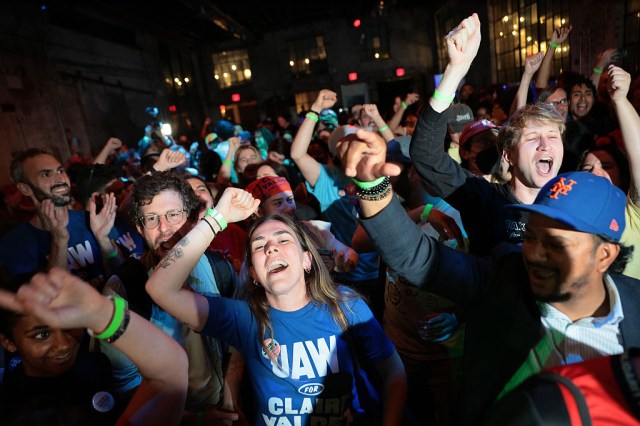
Supporters of NYC congressional candidate Claire Valdez celebrate her victory on primary night. Credit: Getty





Growing up in the Ridgewood neighborhood of Queens, I avoided talking about where I lived. In high school, I said Flushing, the nearest neighborhood anyone knew. At work, I said “east of Williamsburg,” which was the closest “cool” neighborhood I knew. When my wife and I were dating, she, a Puerto Rican from Bushwick, refused to see me in Ridgewood at all. A date there was Taco Bell or Burger King: downscale and embarrassing.
On dates we took the L train at Halsey Street or Myrtle-Wyckoff and rode west into Williamsburg or the East Village, with their hip bars and coffee shops. But on the ride home, I noticed a gradual but seemingly inexorable shift: the transplants — college-educated 20- and 30-somethings who use the city as a playground — would get off one stop later each year. And later, and later.
And in this barely remarkable transformation lies the secret to the political changes sweeping Gotham. The city’s turn to the outré progressive politics of Mayor Zohran Mamdani and the Democratic Socialists of America isn’t just political. It relies upon a remaking of the cultural fabric: how it feels, how it works.
Board the train in Manhattan, and the ride is mostly transplants; continue east, and they thin out, stop by stop, until what is left is the rest of us: the construction workers, the doormen who service the Manhattan co-ops, the immigrant families, the locals, me. But a year ago, my wife and I took the train home, and the train was packed all the way to Ridgewood. Everyone was going to one of the bars that had opened a few blocks from the house I grew up in. I stood the whole way. I could not get a seat in my own local spot.
Ridgewood sits on the seam between Brooklyn and Queens: brick rowhouses, German and Eastern European at first, working class without exception. Its public square was a restaurant, Zum Stammtisch. The name means “the regulars’ table.” Decades later, the Germans made way for Hispanic and Coptic families, who opened their own shops like Rico Pollo or Aghapy Deli. My parents, refugees from Egypt, rented here. Later, on the salaries of two teachers’ aides, they managed to buy a house. There was nothing trendy about the place, but it was safe and stable; I was grateful.
How socialist transplants ruined my New York
What happened to my neighborhood is the ordinary course of gentrification. The hipster was invented in Williamsburg around the year 2000, when the rents were cheap and the neighborhood was unsafe. That, in turn, gave people economic incentives to move in and experiment with coffee shops, new restaurants, thrift stores, and art studios.
The development spiked property values and brought an influx of capital to Williamsburg. The average rent in the neighborhood now is about $5,000 a month, up from shy of $900 at the turn of the millennium. It has a Whole Foods. Naturally, then, those same creative and artsy types moved eastward to Bushwick, whose former industrial areas were rezoned as residential and commercial. But over time, Bushwick rents exploded, given the spread of specialty coffee shops, bars, and electronic-dance-music clubs. Rents exploded to an average of above $3,500, up from under $900 two decades earlier. That’s an exorbitant figure to anyone working outside of finance, tech, and law.
Then, in the mid-2010s, the transplants came to Ridgewood. The change announced itself in an explosion of notable restaurants. Along Forest Avenue, a residential street off Myrtle Avenue, a dozen places have opened in six years, putting Ridgewood on the culinary map. Rolo’s, located in the base of a row house, is considered the best restaurant in Queens. Hellbender, two blocks up, draws the same clientele.
Two years ago, Time Out New York named Ridgewood the fourth-coolest neighborhood in the world. You can browse Instagram for the best restaurants in the Big Apple, and you will often find multiple Ridgewood options listed among them. And, on top of it all, our very own Whole Foods is coming to the old bank I walked past every day. These places, which I now enjoy with my wife, mean I don’t have to take the train to enjoy city amenities. But the change also means I have to make roughly thrice as much as my parents did to afford their home.
Two storefronts on Myrtle Avenue tell the whole story. One is Joe & John’s, a slice shop that serves as a staple of the neighborhood. When the Knicks played, Joe & John’s hosted giant watch parties for the whole neighborhood. Across the street is Topos, a Left-wing café and bookstore that locals studiously avoid.
Walk into Topos, and a poster of Mamdani greets you, flanked by his slate of now-victorious House nominees. A mood board offers the week’s options: an anti-ICE flyer, a women-against-imperialism meeting, a zine calling for the violent overthrow of the government. Keffiyehs are for sale. Young women wear oversized watermelon earrings (a reference to the one-state solution for the Israeli-Palestinian conflict); the espresso machine is peppered with magnets blaring “Free Palestine.”
The music might be Australian lesbian techno-pop or spoken word criticizing America or Lebanese. On the shelves: Abolish Rent, In Defense of Looting, The End of Policing. To the right of the register is a small children’s shelf containing works like Mamdani Walks New York City and Sex Is a Funny Word, billed as an introduction to sex positivity for youngsters. The children’s shelf is tucked away because there are few children. There are only transplants, performing politics fluently for one another.
Standing there, I understood what my neighborhood was becoming: a college town. The tight ring of restaurants, the ideological cafe-bookstores, the absence of families — it all comes together. The Ridgewood transplants are forming an adult campus, their own ecosystem to mimic the liberal college experience.
So like a small college town, there is a spectrum of political involvement, but no objection to the Left-wing ideological system. And underneath this ecosystem is the working class being pushed out by skyrocketing rents and narrowing affordability. The transplants virtue-signal for affordability and call for “decolonizing” the United States, but they are the cause of unaffordability, and they are actively colonizing my home.
When I visited this week, I found a zine called “a new heaven and a new earth” by chariot wish, a self-described transsexual anarchist (capitalization rules are for the oppressor classes). One poem opens: “I wake up every morning in this killing machine called America, and I’m carrying this rage like a blood filled egg, and there’s a thin line between the inside and outside.”
How socialist transplants ruined my New York
This poem, located in this bookstore, in this block that I walked thousands of times near my local pharmacy and my local pizza shop: I cannot help but feel the absurdity. But rage and nihilism toward America form the ideological core of the Ridgewood College ecosystem. Even support of Palestine is done implicitly because Palestine is the tip of the spear in opposing the American imperialist project. The Ridgewood system, and the heart of the DSA itself, represents the nullification of the American way that nurtured me and my family. These ideas gain traction in Ridgewood because of the sheer concentration of transplants, who have a shared restlessness about living in America — perhaps because of their rootlessness. They also have a sense of entitlement created by their artistic and educational attainments, and can’t escape financial stress, notwithstanding their expensive degrees. Hence, they fuel the rise of Mamdani and the DSA.
Claire Valdez, who just took the Democratic nomination for the area’s congressional district — unseating a moderate progressive — is the type exactly. She studied at the School of the Art Institute of Chicago, worked service jobs, and came to New York around 2015 to make art. She did not grow up in Ridgewood and doesn’t, beyond a nominal sense, belong to it. She will soon represent it because the transplants now turn out stronger than everyone else in the Democratic Party. Hers is no longer a congressional seat for a neighborhood, but a congressional seat if the students of Columbia could elect one.
I learned how far the opportunism runs during this year’s nurses’ strike. My wife was on the line; I stood with her in the cold. The corporate Democrats said publicly they wanted workers to achieve a favorable contract but behind the scenes were mostly beholden to the bosses. Given this, the DSA — with Mamdani, Valdez, etc. — seemed like a good partner for the striking nurses. But upon closer inspection, from the point of view of the DSA, the long-term solution to the nurses’ pay crisis isn’t greater bargaining power or stronger contracts, but the dismantling of capitalism itself (with a side of anti-Zionism). This is almost certainly not what the actual working-class nurses want, but when you’re stuck between two opportunistic parties, you go with the one that’s at least with you, even if opportunistically.
That is the pact the DSA has made with my neighborhood and with the Democratic Party. Ridgewood is a staging ground for an ideology its transplants intend to export. For the DSA, it presents an ideal place to organize, run candidates, and enjoy life largely insulated. They will fight for affordability while actively causing the issue: they aren’t interested in managing gentrification but, again, dismantling capitalism. And when the neighborhood is fully gentrified in 10 years, they will blame capitalism while continuing to serve as its agents, and they will move on to the next neighborhood.
Stiven Peter is a divinity graduate student at Reformed Theological Seminary-New York City.
 StvenWithAnI