




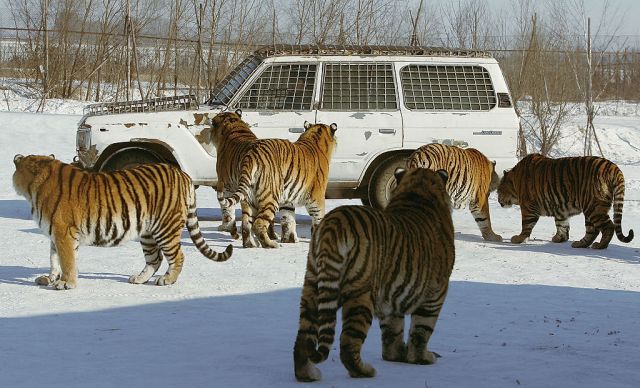
“The Amur tiger is perhaps the wildest creature of them all.” (Guang Niu/Getty)





In the aftermath of the fatal tiger attack at Yorkshire Wildlife Park, a surprising vocabulary emerged to describe Altai. He was a “beautiful cat”, “very receptive”, as well as “nice and calm”. It was as if he were the neighbor’s placid Newfoundland who had unexpectedly turned. So familiar is the sight of a captive tiger, “burning bright” against the soft green of a temperate-country enclosure, no different from where we might see cows grazing, that we have ceased to wonder at its strangeness. Our only comparison is with the cat at home who might be aloof but does, in the end, appreciate a scratch on the tummy. So familiar is the tiger that we might not even be surprised if he spoke to us. But kill us? Just like that? That would make him a monster.
Altai is an Amur, or Siberian, tiger, the largest wild cat in the world. From a population once numbering around 30,000 across Siberia, only about 500 remain in the wild, mostly in the ancient forests of the Sikhote-Alin mountains in the Russian Far East, between China and the Sea of Japan. Much of this forest is uninhabited and virgin. I know because I am one of the relatively few foreigners to have gone there.
My path to that forest and its tigers began much earlier. Some people run away to join the circus: at 16, I left home to work at Edinburgh Zoo, where I stayed for almost two years. The experience ignited in me a fascination with wildness itself, and with what captivity does and does not change in a wild creature. In those days the dangerous, glamorous animals, including the tigers, were allocated to the men, though I spent a great deal of time observing ours. After birds and marmosets, deemed appropriate charges for my age and sex, I graduated to being the largely unseen butler to the great apes.
The principle at the zoo was that animals should remain fit to return to the wild: no petting, no relationships, and no entering the enclosure of a dangerous animal. Our female orangutan would sit behind the bars watching me clean her sleeping quarters, sometimes pushing her huge fingers through. I had been warned not to respond.
One day I looked up from scrubbing the floor and saw her holding a rag, copying me. Our eyes met. I put down my brush and sat opposite her, just beyond the reach of her fingers. Look into the eyes of a great ape and there is a sensation I can only describe as someone being home. There was recognition, kinship, an almost unbearable awareness that this highly intelligent creature and I were divided only by bars and the absence of a shared language. I felt embarrassed, then terribly sad.
The zoo’s director had told me that two kinds of animal suffered particularly in captivity: the thinkers and the roamers. The orangutan was a thinker. Her suffering made sense to me because, as a primate myself, I could recognize something of myself in her.
That experience sharpened my obsession with the tigers. Look into the eyes of an Amur tiger and there is no answering sense of kinship. Asocial, solitary and accustomed to total dominance, the tiger remains illegible to us. But if the orangutan is one of nature’s thinkers, the Amur tiger is one of its roamers, and I wanted to understand it.
Not all zoos worked to keep the barrier between humans and wild animals intact. John Aspinall, the owner of Howletts, built an entire philosophy of animal husbandry on crossing it. He believed close-contact relationships between keepers and their wild charges were not only possible, but desirable. In 1980 two keepers were killed by an Amur tigress in his care; in 1994 the Head Keeper was killed by an Amur male. Aspinall nevertheless insisted the risk was worth it for the animals’ wellbeing. Although his breeding record seemed to bear out his claims, the deaths demonstrated that even undeniably close relationships between Amur tigers and humans did not suppress wild behavior.
Timothy Treadwell made a similar claim for exceptional intimacy with wild creatures, spending 13 summers among Alaska’s grizzlies, who seemed to accept his presence among them. In 2003 he described himself as a “fully accepted wild animal brother to these bears”. Not long after, he and his girlfriend Amie Huguenard were killed by a bear. The error was not his love for these wild animals, but believing that love created an exemption from their nature.
Years after I left the zoo, writing my second novel Tiger, I saw my opportunity to tell a story about Amur tigers that was neither anthropomorphic nor sentimental. In late November 2017, in the depths of the Russian winter, I joined a somewhat seat-of-pants expedition into a closed-off part of the Russian Far East. I crossed 11 time zones, meeting a handful of other Amur besotteds from all over the world before traveling deep into the forest to camp with our Russian guides.
Our goal was to track tigers in the snow and capture them on camera traps. The expensive irony was that we were highly unlikely to see a tiger in the flesh. To those who know the forest, coming face to face with one is a grave failure. Russians and the indigenous Udeghe people alike pay close attention to tracks and signs, careful not to announce themselves in territory that is not theirs: survival depends on avoidance.
The habitat Altai is evolved to dominate is harsh beyond our comprehension in our temperate corner of the globe. Winter temperatures can fall to -36C, with snow six feet deep. A male, or King, Amur tiger controls a territory of around 500 square miles, patrolling and defending the scarce resources within it. Intensely solitary and rarely photographed by humans, it is known among indigenous people as the “Lord of the Forest”.
One day, on a tracking expedition, we found ourselves before the bloodbath of a recently killed boar. The blood was still wet, which meant the tiger was nearby. Our guides, carrying Second World War Kalashnikovs and flares they admitted would not stop an attack, told us to touch nothing. An Amur tiger can be 10 meters away in the winter forest and simply invisible. Its striped coat blends into the striped world of cedar and oak trunks and the shadows between. Its white belly vanishes against the snow.
Should it attack, it would come from nowhere as far as we were concerned. Its large paws make its approach silent; its flat face gathers information like a satellite dish; its ears turn independently towards the smallest sound, and its great snout pinpoints smells it does not forget. It would leap for the neck and snap it in seconds. Invisible yet omnipresent, it had earned its title.
I was afraid. Not anxious: afraid in the way an animal in danger is hyper-alert. My senses sharpened toward what I could not see but could feel. My heart beat faster. Later I would appreciate the discovery that somewhere inside this soft British woman still lies an animal self.
As we stood there, the boar’s heart rolled out. Alexander, our lead guide, eyed it and remarked that it would make “great stew”. The guides debated nervously in Russian. I had read that, according to the Udeghe people, one prohibition is never to take from a tiger’s kill. The tiger, watching, will come for it wherever you go.
The Udeghe worldview is animist: all things, from rocks to tigers, are alive, and the forest is brimming with signs and communications that we in the West dismiss as superstition. But in tiger country, tracks, weather, even the bodily sensation that something invisible is nearby, are relied upon as vital information. What we might call “lore” is the application of acute attention to natural surroundings. Crucially, the tiger is practicing it too.
Our guides were disparaging of this kind of indigenous knowledge. Shamanism has been largely suppressed in Russia. Even so, when it came to it, the risk was deemed not worth taking.
“Time to go,” said Alexander, leading us away and leaving the heart behind.
To feel oneself toppled from the top of the evolutionary tree is a strange experience. In that forest we were not masters of anything, merely conspicuous, poorly adapted animals moving through the territory of a creature infinitely better fitted to its world.
In the zoo, the tiger’s grandeur lies partly in being seen. Its creamy underbelly, orange coat and vivid black stripes resemble a king’s robes: an ostentatious announcement of presence. In human culture, after all, this is how status is signaled. But in the forest, the tiger’s magnificence resides in disappearance, and in the fear of its revelation. Like most large predators, the Amur tiger avoids conflict: injury costs energy. It does not control 500 square miles by being a thug. It is supremely sensitive, cautious and single-minded, the perfect expression of its environment.
We, by contrast, blundered through that environment in deafening North Face outfits, unable to smell, hear or see much beyond what was in front of us. Even a gun could not be fired in time to save us. We were as exposed in the tiger’s world as Altai was in ours.
I think again of Altai in his exposed two-acre paddock, overlooked from every side and even from above. To us he looked regally powerful, but almost every natural advantage had been stripped away except the deepest one: the instinct to survive. Nice, calm, receptive: these are our judgments, not changes in the animal. The captive tiger had not ceased to be what he was; only the forest had been taken away.
When William Chapman entered the enclosure, the avoidance on which tiger and human normally depend was no longer possible. Altai would have known at once that the intruder was male and inside his domain. He was, perhaps, Eliot’s “broken king”, but he defended his tiny territory with the vigor of the Lord of the Forest.