




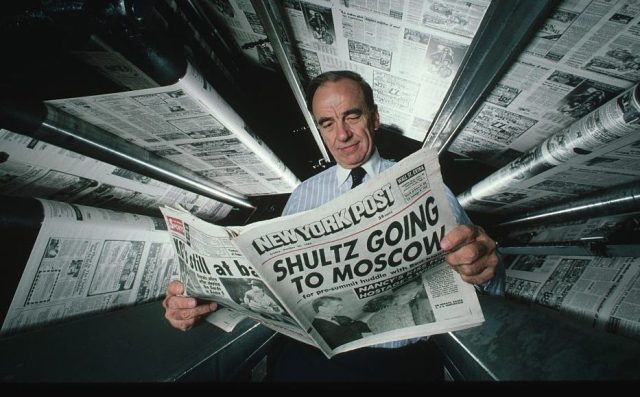
‘Mr Murdoch is trying to smash our union.’ (Roger Ressmeyer/Corbis/VCG/Getty)





In the Eighties, newspapers were still printed using so-called “hot metal”. These machines cast the letters in lead, with lines of type then hand-assembled into a page; which was turned into a mould; which was turned into a metal plate; which was mounted on a press; which — finally — printed the paper. The technology hadn’t moved on much since the Linotype machine had been invented 100 years earlier. This was skilled work, but it was also dirty, sweaty and dangerous, with plate breaks sometimes sending lethal metal shards hurtling across the machine floor.
Understand this grubby, ink-stained world, and it’s tempting to see the 1986 Wapping Print Strike as inevitable. The battle between Rupert Murdoch and his unionised printers ended with those old-fashioned presses replaced by sleek digital alternatives. Yet if the shift looks inevitable in hindsight — as a victory for technology over tradition, of progress over Luddites who refused to move with the times — there was nothing unavoidable about its broader impact. Not only did Murdoch’s new presses mean a radically slimmed-down workforce, it also altered the whole tenor of Left-wing politics, and we’re still living with the consequences today.
Before Wapping, print unions dictated which papers got printed, when and by whom. When, in May 1984, The Sun tried to run a photo of Arthur Scargill with the caption “Mine Führer”, the printers downed tools. When the edition was eventually published, there was a blank space where the picture should have been, accompanied by a text reading: “Members of all The Sun production chapels refused to handle the Arthur Scargill picture and major headline on our lead story. The Sun has decided, reluctantly, to print the paper without either.”
Possibly because of the sector’s heavy unionisation, there was an “us-and-them” feel to journalism: with the editorial staff on one side, and printers firmly on the other. Even a paper’s editor wasn’t allowed to set foot in the machine room, which was strictly reserved for unionised workers. But when Sun journalists went on strike, printers walked through their picket lines day after day. Because of the specialist knowledge required, because of the urgency of getting a paper out on time, and because of decades of bargaining, it was just assumed that printworkers controlled newspaper production, and that’s how it was always going to be. They were in charge.
During the Wapping dispute, though, the nation watched as printers were powerless to stop even a single copy of a single edition of a single paper going on sale. They stood not just defeated, but delegitimised, the fragile limits of their powers starkly exposed. Combined with the failure of the miners’ strike, this loss swept away the Labour-aligned trade union movement which had defined postwar Britain.
At the centre of events was Brenda Dean, the media-friendly leader of the Society of Graphical and Allied Trades. A huge print union — it boasted over 200,000 members in 1980 — Dean was elected SOGAT’s head the year before the strike began. She also had the distinction of being the first woman to be elected as the leader of a major industrial union anywhere in the world, in a sector entirely dominated by men. Dean was herself elected on a programme of industrial reform, and soon became a formidably articulate voice on British TV screens. Acutely conscious of her image, she spent time ensuring that her appearance was always immaculate, turning her bright blue dress into a signature look.
Opposing her was Murdoch. Initially inheriting a single Adelaide newspaper from his father in 1952, he soon created a thoroughgoing Australian media empire. In the Sixties, Murdoch moved into the British market, buying The News of the World and then The Sun, which he turned from a worthy (if boring) Leftist broadsheet into a mass-market tabloid. By the early Eighties, he had added The Times and The Sunday Times to his stable, giving him a powerful foothold across the British press.
But by the time of Dean’s election, Murdoch’s patience was wearing thin. He knew he needed to eliminate the unions, and he used their willingness to strike against them. Aware that he couldn’t construct a state-of-the-art computerised printing plant in secret, he told the world that his new Wapping facility — a decisive move away from the old Fleet Street model — would be used to print an entirely new paper: The London Post. He then goaded his printers into a strike, offering them far worse terms and conditions than they were used to. As soon as the strike began, he sacked the printers en masse, replacing them with workers he’d secretly trained in Southampton. Murdoch must have imagined that the dispute which followed would last only a few months. Brenda Dean had other ideas, rallying her members with a cry of “Mr Murdoch is trying to smash our union!”
She had a point. Murdoch aggressively road-tested Thatcher’s new anti-union legislation. Among other things, strikers were now forbidden from picketing anywhere other than their old places of work — the now dormant facilities in Fleet Street. So-called “secondary action” was made illegal too, meaning non-printworkers couldn’t refuse to handle Murdoch papers. And once the demonstrations at Wapping began, the Metropolitan Police were quick to ensure that the lorries left the plant safely. In the interests of that safety, hundreds of people were injured and one teenager killed.
Yet after months of militancy — and a year of Murdoch’s four papers being printed in Wapping — it became clear that SOGAT’s battle was lost basically as soon as the digital presses started rolling. It wasn’t simply that the new technology was more efficient, allowing the same output with a fifth of the workforce. More fundamentally, the dispute cost the unions their authority. It taught employers that confrontation worked, and that a determined proprietor, armed with new machines and new legislation, could execute a complete end-run around organised labour.
And where Murdoch started, others followed. By 1990, every national newspaper which had previously been printed using hot metal on Fleet Street had moved to computerised facilities, often in the Docklands. Other unions found their hands were tied by the new legislation too. The Liverpool Dockers strike of 1995-1998 remained almost entirely isolated; in the Seventies, it’s easy to imagine other workers downing tools in solidarity.
Altogether, these actions tipped the economic balance of power away from workers and towards employers, eroding participation in collective bargaining arrangements. As for the country at large, it was hard not to feel as though socialism had lost the intellectual argument. In earlier decades, capitalism and socialism were the titans fighting for Britain’s soul. Yet once both the miners and the printers had taken on the Right and lost, it became clear that organised labour could no longer set the agenda.
This unsurprisingly had an impact on the Labour Party. It had, after all, been founded by trade unions. But after Wapping, union membership declined sharply, and the tone of Labour’s rhetoric shifted from opposing plutocratic tycoons to merely tempering their influence. The 1983 manifesto talks about large-scale nationalisation, even (perish the thought) withdrawal from the EEC. Compare that to its 1992 successor, which emphasises competence and fiscal responsibility. Then, in 1997, Tony Blair won the vote to replace Clause IV of Labour’s constitution, dumping a commitment to public ownership that had endured since 1918.
1986 may not have been the only pivot on which this new world turned, but it was surely decisive. From then on, the Left stopped arguing that a socialist Britain was a fair and prosperous Britain, and was instead reduced to trying to curb capitalism’s worst excesses. As for Rupert Murdoch, he didn’t just win the strike. He helped re-write the political map of the UK. In the Print, the play we’ve written about the dispute, isn’t just an account of a thrilling battle for power. It’s also a warning.
In 1986, computerised presses meant that 1,000 people could produce four national newspapers. With the rise of the internet, that looks almost quaint. Now we barely need newspapers to be printed at all, as most journalism is consumed on screens. And now, in 2026, we face another turning point, as AI means people are barely even needed to write the articles. The unions of the Eighties might have been flawed, overreaching and at times even absurd — but they had the power to stop a runaway train in its tracks if necessary. We might soon look back on that power with envy.
***
In the Print is showing at the King’s Head Theatre in Islington until 3 May.