




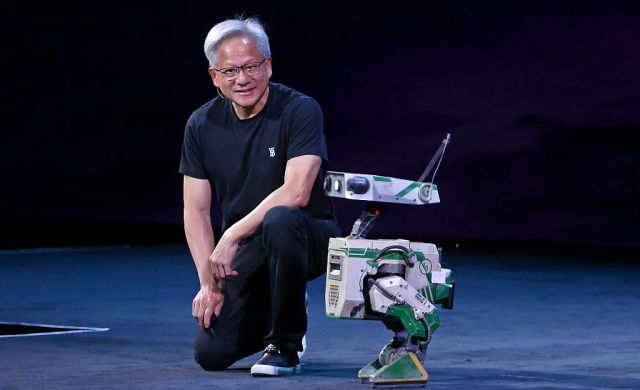
‘We all know that this way of living is completely unhealthy.’ (Chesnot/Getty)





As Americans prepare for their annual Black Friday rites of debt-financed excess, the economy’s true nature has revealed itself through an even stranger event: the return of Jensen Huang. Little could better illustrate America’s two-tiered system of economic justice. The fact that Nvidia was deemed too big to face consequences for its CEO’s actions, much less fail, illustrates two things.
First, nothing has fundamentally changed since the 2008 financial crash. Second, what has changed has been a movement in the same direction that caused the crash to start with: growth based on deceit rather than actual value-added. Do the AI companies actually make money? Do they contribute new value, or merely steal it from everyone else for their enormous gain? No one seems to care. Certainly not investors, certainly not the President. But when your economy is built on sand, you can’t fire the architects of the sandcastle.
Economist Yanis Varoufakis has dubbed our present state of affairs “technofeudalism”. In this same vein, I have previously offered the alternative “hyper-feudalism”. But the Huang affair brings our grim reality into even sharper relief, for it makes clear that our present system is one where the tech giants are building a system of total dependence — without any notion, much less guarantee, of reciprocity towards the public at large.
A serf, at least, was owed something, which is more than can be said for the creature whose situation ours most resembles. The way we live now would be better labelled “battery-farm capitalism”. Think of it as a civilisational frequency, one where we all power a giant wealth-extraction machine that everyone must remain plugged into — at all times — to keep the deception of benevolence alive.
Yes, everyone will someday have everything provided for them by “machines of loving grace” — the actual title Anthropic CEO Dario Amodei used for a recent essay. This brand of soft-pedalled progressivism serves as the nucleus of how Silicon Valley and Wall Street joined forces over the last 30 years to remake the economy in a way that ensures they hoover up all the money, and all the resources, and everyone else simply accepts their station as rudderless plebs, keeping the “attention economy” afloat through the power of their addiction to social media and other forms of pointless entertainment.
As they say on therapy TikTok, “when people tell you who they are, believe them.” Indeed, in a recent Wall Street Journal profile, that’s precisely what happened with Amodei. The Journal documented that Anthropic’s CEO at one point seriously floated the notion that in the employment-free economy of the future, highly immersive video games would be needed to pacify young men — and keep them from coming after their social betters in Silicon Valley, who, of course, ought to remain the rightful rulers of the economic multiverse.
Donald Trump may enable this, but, for what it’s worth, he’s no technophile futurist — as his embarrassing “everything computer” White House lawn advertisement for Tesla illustrated. Still, with all the chaos surrounding Iran and the Strait of Hormuz, in other words a tangible economic problem, Trump learned something essential. In a second-by-second attention economy, the machine cannot be turned off — even for a moment.
Trump instinctively knew that “we” — investors on Wall Street like himself — could not risk letting Nvidia and the AI-ready microchips they produce falter because LLMs have already, just as their makers hoped, become as essential to our lives as petrol-powered transport, albeit far less useful.
That suggests a far deeper transformation. The problem with talk of “late capitalism” has always been fairly simple. Today’s obscenely unequal “free market” structure isn’t collapsing. Not even remotely, at least not in terms of keeping the masses sated and distracted. Rather, what’s collapsing are the moral foundations of liberalism itself.
The AI economy and tech IPOs are killing the Protestant work ethic, and indeed the civic-mindedness on which capitalism depends. Nearly every tech “growth company” — from OpenAI to Anthropic to Tesla — is priced not on profit but on the promise of eventual trillions, and the whole advantage evaporates the moment the market decides they’re “mature”. The crash risk is, of course, familiar, but the deeper story is what price valuation-without-profit does to liberalism’s core: tying reward to productive effort. Instead of working from that basis, in the mould of both Max Weber and Christopher Lasch, our economic system now mints unprecedented fortunes through mere anticipation, teaching its ambitious young people that actual productive work is for suckers. Social media influencer culture — fed rhetorically and literally by people like Amodei — feeds into this deception: with its “branding” logic eerily symbiotic to the work pursued by the AI giants themselves.
Liberalism is a concept distinct from both democracy and capitalism. Yet in the bleak world social-media executives and tech-monopolists are erecting, liberal democracy is becoming less and less possible. To that extent, the 2020s can be understood as in-between space, one where a new form of totalitarianism is assembling itself all around us. That future may not be feudal, but it’s capitalist all the same.
Marx wagered that the capitalist class would eventually push its insatiable urge for ever-more profits with ever-greater productive efficiency into the total immiseration of working people, creating an insurmountable contradiction that would bring down the liberal, post–feudal order.
A generation later Werner Sombart — the sociologist who actually made the word “capitalism” stick — asked why there is no socialism in the United States. Sombart, like the theorist Eduard Bernstein before him, pointed out that Marx — despite all the religiosity surrounding his thought — was plain wrong that capitalism was immiserating the proletariat. American socialism, he concluded, failed to appeal on the basis of the “roast beef and apple pie” abundance seen in the country’s growing middle class. It goes without saying that those days are long gone. Even Ivy League graduates stare down the grim face of unemployment today. Could it be, then, that Marx was indeed correct about the inevitable immiseration of the masses, but that the whole affair simply took 150 years longer than he anticipated?
A century after Sombart, our supply of “roast beef” is getting smaller and more expensive by the day. Yet no new heterodox political movement of any size exists. Nobody is storming anything, which suggests that the system has found something cheaper — and more efficient — than roast beef to feed us.
Nothing that happens in the modern American battery-farm offends any actual liberal-individualist principle. No one is coerced, the fruits of screen-addiction are freely offered and freely consumed. Every consumer has, in the parlance of our times, clicked “agree” several times over somewhere down the line. All our liberal formalities have stayed on the books. We still vote, we can still hire attorneys to sue, we still post dissenting opinions on publications.
Meanwhile, the creature for whom American liberties were designed for — the church-going, community-minded, God-fearing, family-oriented citizen — is in the process of going extinct. Everyone knows this, of course, and everyone is dissatisfied. And yet we remain completely unmotivated to do anything beyond what’s convenient on our hand-held devices. Battery-farm capitalism cannot stop: not just because of the relentless ATM machine it provides for those with the largest stock portfolios, but because, without it, we might cease to function as batteries for this hideous machine and start talking to each other again.
As it is, screen addiction has created a professional class wholly unwilling — and increasingly unable — to read anything other than short-form texts. A supposedly well-educated stratum of the population is entirely dependent on subscription-based LLMs to complete their professional duties or express thoughts beyond a few hundred characters. Meanwhile, our poor and working classes exhibit levels of literacy that are quickly making Mike Judge’s Idiocracy seem prescient.
Everything is getting faster, yet also infinitely dumber. The hallmarks of AI-produced writing have crept into practically all forms of communication. News stories. Substack posts. Advertisements. YouTube videos. Press releases. Undergraduate writing assignments. Peer-reviewed scholarship. You name it and inside that space the AI-driven enshittification of thought is already the norm. Within a remarkably short period of time, since OpenAI debuted ChatGPT four years ago, almost everyone with internet access has let AI do the heavy-lifting of writing and thus, thinking, for them.
In 2020, Covid-19 was dubbed the greatest virus humanity had faced in a century. Not long after, Elon Musk began tweeting about the great “mind-virus” of wokeness infecting the planet’s elites. But as dangerous viruses go, both were small fry. The greatest infection to ever face human thought is clearly our self-consuming dependence on machines to do the thinking for us. To that extent, yes, Jensen Huang had to be reinstated because the AI golden goose must continue to lay its IPO eggs. Just as important, though, he needed to be reinstated because LLMs have become a kind second brain — and a reassuringly dull one at that.
We all know that this way of living is completely unhealthy. We all know that, economically speaking, we’re getting ripped off. We all know that the people in power are utterly self-interested. But like most battery hens, even when offered a way out of our cages, we stay put because everyone else is doing the same.
B. Duncan Moench is a writer and scholar of American political culture. He also writes the Producerist Substack.
 DuncanMoench